Coin Grading Basics
What coin grading is, why it matters, the 1-70 Sheldon scale, circulated vs. uncirculated, market vs. technical grading, and the surface factors (strike, luster, marks, eye appeal) that move a grade.
Last reviewed: · Free to read · Every claim sourced
What is coin grading and why does it matter?
In plain English
Grading is rating a coin's condition on a shared 1-to-70 scale so collectors everywhere mean the same thing by a 'grade.' It matters because, after rarity, condition is the biggest driver of a coin's value, and learning to grade protects you from overpaying.
Going deeper
A grade blends measurable wear with surface preservation, strike, and (in market grading) eye appeal. Because judgment is involved, the same coin can receive slightly different grades from different graders or services. Authentication always precedes grading: a coin must be genuine before any grade applies.
Sources: American Numismatic Association (ANA) · Professional Coin Grading Service (PCGS) · Numismatic Guaranty Company (NGC)
What is the Sheldon 1-70 grading scale?
In plain English
U.S. coins are graded from 1 (barely identifiable) to 70 (flawless). Numbers below 60 are circulated coins that show wear; 60 through 70 are Mint State (uncirculated) coins with no wear.
Going deeper
The scale traces to Dr. William Sheldon, who introduced a 70-point system for early American large cents (the book 'Early American Cents') originally as a basal-value pricing formula. The ANA later adapted it to all U.S. series (Whitman, 1977). The scale is not linear in price: a one-point move at the top (MS-65 to MS-66) can mean a large jump in rarity and value.
Sources: The Official ANA Grading Standards for United States Coins · Professional Coin Grading Service (PCGS) · Numismatic Guaranty Company (NGC) · American Numismatic Association (ANA) · Coin World
Why does the scale stop at 70?
In plain English
The numbers aren't a 0-to-100 score. Dr. Sheldon was actually pricing early large cents: he noticed the finest example of a given coin sold for about 70 times what a barely-identifiable one did. So a 'basal' (Poor) coin was the 1, and a flawless coin was about 70, and the scale stuck.
Going deeper
Sheldon's 1949 system was a value formula, not a quality percentage. For a given large-cent variety, a coin's grade number multiplied by its 'basal value' was meant to approximate its market price: Poor = 1x the base, and a perfect coin roughly 70x. The ceiling of 70 reflected that observed ~70-to-1 price ratio. The hobby later kept the 1-70 numbers purely as a condition scale even after prices stopped tracking the multiplier, so 70 survives as an inherited convention rather than an arbitrary round number.
Sources: Professional Coin Grading Service (PCGS) · Coin World
Circulated vs. uncirculated (and About Uncirculated)
In plain English
A circulated coin shows wear from being used; an uncirculated (Mint State) coin shows none. The trickiest line is between About Uncirculated (AU) and Mint State (MS): an AU coin has just a trace of wear on its highest points.
Going deeper
AU-58 is the highest circulated grade and can have superb luster and eye appeal, sometimes more attractive than a low Mint State coin (MS-60/61), which has no wear but can show dull luster and many contact marks. The presence of any genuine wear (not merely a weak strike) keeps a coin in AU.
Sources: The Official ANA Grading Standards for United States Coins · Professional Coin Grading Service (PCGS) · Numismatic Guaranty Company (NGC)
Market grading vs. technical grading
In plain English
Technical grading scores only the physical facts (wear, marks, strike). Market grading also weighs how attractive and marketable the coin is. Modern U.S. grading leans toward market grading.
Going deeper
As the ANA puts it, with technical grading you are 'grading' the coin; with market grading you are 'pricing' it. Eye appeal is a real component above MS/PR-60, and both major services reward it with special designations (PCGS '+' grades; NGC 'Star').
Sources: American Numismatic Association (ANA) · Professional Coin Grading Service (PCGS)
Evidence pages
What moves a grade: strike, luster, marks, eye appeal
In plain English
Four things separate similar coins: strike (how fully the design was stamped), luster (the original mint shine), contact marks (tiny dings), and overall eye appeal. Importantly, a weak strike is not wear, it's there from the moment the coin was made.
Going deeper
Evaluate strike separately from wear: weak-strike softness is mint-made, while wear is post-mint metal loss. Intact 'cartwheel' luster signals an original, unworn, uncleaned surface. On Mint State coins, the number and location of contact marks (e.g., on a Morgan dollar's cheek) drive the grade. Eye appeal, luster, color, strike, freedom from distractions, can move a coin within a grade and is central to market grading.
Sources: Numismatic Guaranty Company (NGC) · Professional Coin Grading Service (PCGS) · The Official ANA Grading Standards for United States Coins
Problem coins: Details and net grades
In plain English
A genuine coin with a problem, cleaning, damage, corrosion, or altered surfaces, usually can't get a normal number grade. Modern services give it a 'Details' label instead (for example, 'XF Details. Cleaned'), and it's worth much less than a problem-free coin.
Going deeper
Details grading authenticates the coin as genuine and describes its detail level while naming the disqualifying problem, rather than assigning a 1-70 number. An older approach, net grading, instead folds the problem into a single lowered number. PCGS and NGC predominantly use Details grading today.
Sources: Professional Coin Grading Service (PCGS) · Numismatic Guaranty Company (NGC) · The Official ANA Grading Standards for United States Coins
What each grade looks like
The fastest way to learn grades is to see them. Here is the same idea in two metals, silver coins on one rail and copper cents on the other, from Mint State at the top down to Good. Watch how the high points flatten and the detail fades as the grade drops.
Higher number, better condition. Tap a grade to jump to real examples below.
These are illustrative examples chosen to show roughly how much wear each grade band shows. They are not certified grades, and dates differ between examples. A coin's true grade depends on strike, luster, marks, and eye appeal, and is best confirmed by a professional grading service.
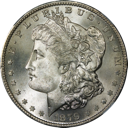
No wear at all. Full mint detail and original luster; only contact marks, strike, and eye appeal separate one Mint State grade from the next.
Only a trace of wear on the very highest points (the cheek and hair on a Morgan, the jaw and wheat tips on a cent). Most of the luster is still there.
Light wear on the high points, but every major feature and most of the fine detail is still sharp and clear.
Moderate, even wear. Major features stay bold while finer detail, like strands of hair or the lines in the wheat ears, is partly worn away.
Moderate to heavy wear. The design reads clearly in outline, but a lot of the interior detail has gone flat.
Well worn. The main design is clear but flat, the lettering is readable, and the rims are still essentially complete.
Very heavy wear. The design is a mostly flat outline with the date readable; the rims are worn and may touch the tops of the lettering in spots.
Photo credits: Photo: Brandon Grossardt, CC BY-SA 3.0, via Wikimedia Commons; Public domain, via Wikimedia Commons; Photo: Tom Hilton, CC BY 2.0, via Wikimedia Commons; Photo: DD1380, CC BY-SA 4.0, via Wikimedia Commons; Photo: Lost Dutchman Rare Coins, Public domain, via Wikimedia Commons; Photo: Jerry "Woody", CC BY-SA 2.0, via Wikimedia Commons; Photo: Doronenko, CC BY 3.0, via Wikimedia Commons; Photo: Brett Levin, CC BY 2.0, via Wikimedia Commons; Photo: Ron Clausen, CC BY-SA 4.0, via Wikimedia Commons; Photo: Mintaren, CC BY-SA 4.0, via Wikimedia Commons; Photo: Bcgood1973, CC BY-SA 4.0, via Wikimedia Commons.
One coin, every grade: the Morgan gallery
Below is the same design, the Morgan silver dollar, at twelve points up the Sheldon scale. Every image is cropped to the same size and framing, so as you click through, the only thing changing is the coin's condition: watch the hair above Liberty's ear, the cotton leaves in her cap, and her cheek. Tap any coin to open the gallery, then use the arrows to step up and down the scale.
Circulated examples (marked ≈) are our own wear estimates from photographs, not professional grades; the Mint State examples are certified, and the label under each coin says by whom. No freely licensed Morgan photos exist for MS-60 through MS-62 or MS-68 and above, so those steps are described in the table that follows the gallery.
Mint State, step by step: MS-60 to MS-70
Every Mint State coin is uncirculated; the eleven MS steps are separated by contact marks, luster, strike, and eye appeal. Here is the whole run, including the steps no freely licensed Morgan photo exists for:
- MS-60
- Uncirculated but ugly is allowed: no wear at all, yet heavy or numerous marks, dull luster, and poor eye appeal. A baggy MS-60 can look worse at arm's length than the AU-58 above it; the difference is that nothing on it is worn.
- MS-61
- Still heavily marked, but slightly fewer or less severe hits than MS-60. Luster may be impaired.
- MS-62
- Noticeably marked with average luster; the marks are smaller or better hidden than on 60–61. The last of the “baggy” grades.
- MS-63 pictured above
- “Choice”: full luster with scattered marks, some in focal areas like the cheek. The most commonly traded Mint State grade for vintage coins.
- MS-64 pictured above
- Near gem: clean at first glance; a mark or two in a focal area, or a small cluster elsewhere, is all that separates it from 65. The price jump from 64 to 65 is often the largest on the whole scale.
- MS-65 pictured above
- Gem: strong luster and eye appeal, with only minor marks and none that draw the eye to focal areas.
- MS-66 pictured above
- Premium gem: superior luster and nearly mark-free surfaces; anything present is trivial and hidden in the design.
- MS-67 pictured above
- Superb gem: sharp strike, outstanding luster, and only the faintest imperfections visible under magnification.
- MS-68
- Nearly perfect, with tiny flaws detectable only under a loupe and never in focal areas. Only a handful of Morgans exist this fine, and no freely licensed photo of one exists.
- MS-69
- Virtually perfect: essentially no post-strike flaws at 5x magnification. Vintage coins almost never survive this well; for Morgans the certified population is a coin or two.
- MS-70
- Perfect under 5x magnification, exactly as struck. No vintage Morgan dollar has ever graded MS-70; in practice 70s exist only on modern coins struck, handled, and slabbed under controlled conditions, like the 2021 Morgan reissues.
Below Good sit About Good (AG-3), Fair (FR-2), and Poor (PO-1): the rim wears into the lettering, then the date becomes barely readable, then the coin is little more than an identifiable silver disc. Heavily worn Morgans were usually melted rather than saved, so photogenic examples are scarce; picture the G-4 above with its rim and legends progressively erased.
Gallery photo credits: Photo: Mintaren, CC BY-SA 4.0, via Wikimedia Commons; Photo: Bruxton, public domain, via Wikimedia Commons; Photo: Brett Levin, CC BY 2.0, via Wikimedia Commons; Photo: Jerry "Woody", CC BY-SA 2.0, via Wikimedia Commons; Photo: DD1380, CC BY-SA 4.0, via Wikimedia Commons; Photo: Tom Hilton, CC BY 2.0, via Wikimedia Commons; Photo: Bobby131313, CC BY-SA 3.0, via Wikimedia Commons; Photo: Brandon Grossardt, public domain, via Wikimedia Commons; Photo: Bruxton, CC0, via Wikimedia Commons; Scan: coins2.calkinsc.com, public domain, via Wikimedia Commons; Photo: Brandon Grossardt, CC BY-SA 3.0, via Wikimedia Commons.
Key terms in this lesson
Grade · Sheldon Scale · Circulated · Mint State · About Uncirculated (AU) · Market Grading · Technical Grading · Strike · Weak Strike · Luster · Contact Marks · Eye Appeal · Details Grade · Net Grade