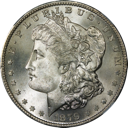
Grading the Peace Dollar
The Peace dollar (1921-1935, revived in 2021 and struck annually since 2023) is a large 90% silver coin designed to mark peace after World War I. To grade it, look at the hair over Liberty's ear and the eagle's feathers, these high points wear and strike weakly, especially on the dramatic high-relief 1921. The modern coins are a different product, struck in .999 fine silver instead of the old 90% alloy.
Last reviewed: · Free to read · Every claim sourced
New to grading? Start with how to grade a coin, step by step, and the Sheldon 1-70 scale.
At a glance
| Years | 1921-1935; revived 2021 and struck annually since 2023 |
|---|---|
| Designer | Anthony de Francisci. |
| Denomination | One dollar (silver) |
| Specifications | Vintage: weight 26.73 g; diameter 38.1 mm; reeded edge. 1921 (and a little of 1922) struck in very high relief. 2021 revival: 0.858 oz silver, 38.1 mm. |
Composition over time
| Period | Composition |
|---|---|
| 1921-1935 | 90% silver, 10% copper |
| 2021 revival | 99.9% silver (NOT the vintage 90/10 alloy); not struck in high relief |
Where wear shows first
- Obverse: the ridge of vertical hair over Liberty's ear
- Reverse: where the eagle's wing meets its leg, and the eagle's feathers
Common weak-strike areas
- Central devices, Liberty's hair over the ear and the eagle's feathers, are typically weak, especially on the 1921 High Relief
Strike designations
No official Full Head/Full Bands-type designation; strike is described narratively.
Grading circulated coins
Good (G-4): Liberty's hair is worn to a nearly flat plane with only deep outlines around the face and tiara rays, and the eagle's wing and back are smooth, though LIBERTY, the date, and the rays remain readable. Very Good (VG-8): a few thick hair strands separate near the ear and the neck bun, and the eagle regains a feather outline along the wing edge. Fine (F-12): the hair over the ear and eye shows moderate strand detail broken by flat spots, and partial feather detail returns to the wing. Very Fine (VF-20): hair strands over the ear and eye are distinct though worn, roughly half the feather detail shows, and the tiara rays are full. Extremely Fine (EF-40): hair over the brow and ear is strong with wear only on the highest waves, and all feathers show though the back and leg are soft. About Uncirculated (AU-50): a trace of friction on the hair over the eye and ear, the cheek, and the eagle's shoulder. With this low-relief design, broken luster is a more reliable wear indicator than missing detail. Caveat: the 1921 high relief and many 1920s Philadelphia issues are almost always weakly struck at dead center, so flat hair over the ear on a coin with unbroken satiny luster is strike softness, not circulation.
Grading Mint State coins
Mint State Peace dollars turn on Liberty's cheek and neck as the mark-prone focal areas, on the series' distinctive creamy satin luster, and heavily on strike, since central weakness plagues the series (the 1921 above all). Prooflike surfaces are almost unknown on Peace dollars because of the dies' texture; PL labels are vanishingly rare compared with Morgans.
Key dates
- 1921, the first-year high-relief issue, struck for one year before the relief was lowered; always soft at the central hair
- 1928, the lowest mintage of the series (360,649), a key in every grade and widely counterfeited
- 1934-S, common in circulated grades but the series' great condition rarity in Mint State
- 1927-D, scarce in Mint State with a decent strike
Semi-key dates
- 1925-S and 1928-S, condition semi-keys that get expensive above MS-63
- 1934-D, a tougher Denver issue that comes with several mintmark sizes
Major varieties
- 1922 High Relief, the transitional rarity struck before the design was flattened: a matte proof issue and a small handful of business strikes
- 1934-D Doubled Die Obverse, with large and small mintmark varieties
- 1922 'field break' VAMs such as VAM-2C 'Extra Hair', popular with VAM specialists
Common problems
- Weak central strikes (hair over ear); cleaning; die-struck counterfeits
Counterfeit & alteration risks
- 1921 High Relief is a frequent target; NGC counterfeit indicators include odd proof-like fields, raised lumps on devices, pitting around letters, and excess thickness on non-silver fakes
For the advanced grader
Central weakness on the hair over the ear and eagle is common, so distinguish strike from wear; the 1921 High Relief is especially soft and short-lived in die life. Watch for die-struck fakes (odd prooflike fields, raised lumps, pitting) and weigh non-silver fakes. Keep the vintage 90% silver coin distinct from the 2021 .999 revival.
Photographic examples
Click any image to enlarge and zoom. Where shown, obverse, reverse, and edge views are of the same coin and year.
Same coin: 1921 Peace dollar (high relief, first year)
More dollars to explore
Sources: Professional Coin Grading Service (PCGS) · Numismatic Guaranty Company (NGC) · United States Mint · Coin World
Evidence pages
Related terms
Weak Strike · Luster · Contact Marks · Counterfeit · Cast Counterfeit