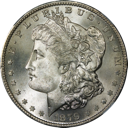
Grading the Barber Half Dollar
The Barber half dollar (1892–1915) by Charles Barber shows Liberty in a cap with LIBERTY on her headband; the reverse is a large heraldic eagle with a shield and E PLURIBUS UNUM. Grade a worn one by counting LIBERTY's letters, gone is about Good, three readable is Very Good, all seven readable is Fine or better, and by how sharp the eagle is. Keys include 1892-O, 1893-S, 1897-O, 1904-S, 1914 and 1915; have key dates certified, since several are faked.
Last reviewed: · Free to read · Every claim sourced
New to grading? Start with how to grade a coin, step by step, and the Sheldon 1-70 scale.
At a glance
| Years | 1892–1915 |
|---|---|
| Designer | Charles E. Barber |
| Denomination | Half Dollars |
| Composition | 90% silver, 10% copper (0.36169 troy oz silver) |
| Diameter | 30.6 mm |
| Weight | 12.50 g |
| Edge | Reeded |
| Mints | Philadelphia (no mintmark), New Orleans (O), San Francisco (S), Denver (D) |
Where wear shows first
- The LIBERTY headband (letter count is the classic grade gauge)
- Liberty's cheek and the high point of the cap/forehead
- Reverse: the eagle's head, breast feathers, wing tips and tail tips
Other points to check
- The laurel wreath leaves in the hair
- The shield lines and the E PLURIBUS UNUM ribbon on the reverse
Common weak-strike areas
- LIBERTY headband on pre-1909 dies (weaker as struck; the 1909 hub strengthened it)
- Reverse eagle: high points of the breast feathers, head, wing tips, tail tips and the upper-right shield detail can be soft from striking
- Reverse rim and dentils on some branch-mint strikes
Strike designations
No strike designation applies to the Barber half. Proof contrast designations Cameo and Deep/Ultra Cameo apply to the Philadelphia proofs.
Grading circulated coins
Read LIBERTY-letter count on the headband together with the reverse eagle. Good (G-4): LIBERTY worn away/illegible (often only LI or LIB faintly remains) with a full rim and bold portrait; reverse eagle mostly an outline, shield flattened but E PLURIBUS UNUM clear of the field. Very Good (VG-8): at least 3 letters of LIBERTY readable; eagle shows shield and wing outline. Fine (F-12): all 7 letters of LIBERTY visible (ER often weak); the eagle's head and neck are bold and separated, major wing-feather groups bold with finer detail flat, E PLURIBUS UNUM full on the ribbon, full LIBERTY is the line between Fine and Good. Very Fine (VF-20): full strong LIBERTY, complete hair detail and complete eagle feathers, partial mint luster may remain. Extra Fine (EF-40): LIBERTY and E PLURIBUS UNUM sharp and crisp, only slight high-point wear on the cheek and the eagle's head/wing tips. Caveat: pre-1909 coins can show naturally weak LIBERTY (mint-made), weight the cheek and reverse eagle accordingly.
Grading Mint State coins
On this large coin Mint State turns on the cheek, the open obverse fields and the eagle's breast, where marks and rub show first. Luster quality and full strike (sharp breast/tail feathers, full LIBERTY) separate gems. Several dates affordable circulated (1901-S, 1904-S, 1907-S) are major condition rarities in MS65+.
Proof grading
Proofs were struck at Philadelphia each year 1892–1915, graded on mirror-field depth and freedom from hairlines/contact, with Cameo and Deep/Ultra Cameo contrast designations; cleaning hairlines are the common grade-limiter.
Key dates
- 1892-O, scarce inaugural-year New Orleans issue (plus the rare 1892-O 'Micro O' small-mintmark variety)
- 1893-S, key date, low mintage, scarce in all grades; heavily faked, so have any example certified
- 1897-O, scarce in all grades (mintage ~632,000)
- 1914 and 1915, low-mintage Philadelphia keys of the final years
- 1904-S, condition rarity, common low-grade but expensive in high grade
Semi-key dates
- 1892-S, 1897-S, 1901-S, 1907-S, semi-keys / condition rarities (cheap worn, costly in EF and above)
Major varieties
- 1892-O Micro O (smaller mintmark)
- Pre-1909 vs 1909+ hubs (the 1909 hub strengthened LIBERTY on the headband)
Common problems
- Cleaning / whizzing and old harsh dips
- Cheek and field contact marks capping Mint State grades
- Weak reverse-eagle strike mistaken for wear (esp. pre-1909 and branch-mint)
- Rim bumps and environmental damage on this heavily circulated silver type
Signs of cleaning or damage
- Hairline scratches across the large open fields
- Unnatural brightness / whizzing on the cheek and eagle
- Disturbed or broken luster
Toning
The large silver surface takes deep, attractive album and bag toning (russet, gold, blue, iridescent) that adds value when original; recolored/artificially toned coins often hide cleaning and are penalized.
Counterfeit & alteration risks
- 1892-O and 1893-S: added or altered mintmarks and struck/cast fakes; on the no-mintmark 1914 and 1915 Philadelphia keys the risk runs the other way, removed mintmarks and altered dates
- 1893-S specifically: professional certification is essential before any purchase
- 1892-O Micro O: verify the mintmark punch is the correct small style
For the advanced grader
Read LIBERTY and the eagle together; allow for naturally weak LIBERTY on pre-1909 dies (the 1909 hub strengthened it) so you don't over-grade a soft strike as wear or under-grade it as circulation. Authenticate the keys before grading: for the 1893-S verify the mintmark style and insist on certification; for 1892-O distinguish the Micro O; on the no-mintmark 1914 and 1915, watch for removed mintmarks and altered dates. Identify the condition-rarity dates (1901-S, 1904-S, 1907-S), cheap worn but very expensive in high grade, when deciding whether certification is worthwhile.
Photographic examples
Click any image to enlarge and zoom. Where shown, obverse, reverse, and edge views are of the same coin and year.
Same coin: 1899 Barber half dollar
More half dollars to explore
Sources: Professional Coin Grading Service (PCGS) · Numismatic Guaranty Company (NGC) · Coin World · Wikipedia (numismatics articles)
Related terms
Wear · Weak Strike · Luster · Altered Date · Mintmark · Cameo (CAM / CA) · Toning