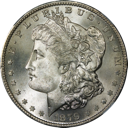
Grading the Walking Liberty Half Dollar
The Walking Liberty half (1916–1947) is a 90% silver coin with the striding Liberty design later reused on the Silver Eagle. Many were softly struck, so a flat head, hand, or skirt may be a weak strike rather than wear. The keys are the early dates, especially 1921-D (lowest mintage), and 1916–1917 come in two mintmark-placement subtypes.
Last reviewed: · Free to read · Every claim sourced
New to grading? Start with how to grade a coin, step by step, and the Sheldon 1-70 scale.
At a glance
| Years | 1916–1947 |
|---|---|
| Designer | Adolph A. Weinman |
| Denomination | Half Dollars |
| Composition | 90% silver, 10% copper (0.3617 oz pure silver); unchanged across the series. |
| Diameter | 30.6 mm |
| Weight | 12.50 g |
| Edge | Reeded |
| Mints | Philadelphia (no mintmark), Denver (D), San Francisco (S) |
Major subtypes
| Subtype | Years |
|---|---|
| Obverse-mintmark type | 1916 & early 1917 (D/S in the obverse field below IN GOD WE TRUST) |
| Reverse-mintmark type | later 1917–1947 (mintmark on reverse, lower left below the pine sapling) |
| Proof issues | 1936–1942 (Philadelphia, brilliant proofs) |
Where wear shows first
- Liberty's head
- Center of the body/skirt lines over the leg
- Liberty's left hand/branch
- Eagle's breast and left leg (reverse)
Other points to check
- Sun's face and rays
- Liberty's right arm and the flag drapery
- Date area
Common weak-strike areas
- Liberty's head and the central skirt/gown lines over the leg
- Liberty's left hand and the branch, directly opposite the eagle's breast/leg, so metal starves both
- Eagle's breast and left leg (reverse); San Francisco and early Denver issues are notoriously soft
Strike designations
No official full-strike designation exists for Walking Liberty halves; strike quality affects only the numeric grade and eye appeal.
Grading circulated coins
Good (G-4): Liberty is worn to a full outline with no skirt lines, her head and breast merge into single smooth surfaces, and the eagle is flat with strong rims and readable legends. Very Good (VG-8): a few gown lines reappear at the waist and the breast regains a defining outline. Fine (F-12): skirt lines are visible from the waist down across the left leg though incomplete and weak, and the breast is fully outlined. Very Fine (VF-20): the skirt lines run complete from waist to hem though worn, sandal and branch detail return, and the eagle's breast and leg feathers begin to separate. Extremely Fine (EF-40): all gown lines are sharp, Liberty's head shows hair detail with a flat spot only at the temple, and the eagle's breast shows feathers with wear confined to the highest curve. About Uncirculated (AU-50): just a trace of friction on Liberty's head, breast, and left leg above the sandal, and on the eagle's breast and forward leg; check for broken luster on the leg first, since it is the true high point. Caveat: strikes before 1921 and from the 1940s San Francisco Mint are chronically weak at the head, hand, and skirt lines, so incomplete lines on a coin with full unbroken luster indicate strike, not wear. Grade those coins by luster and the leg.
Grading Mint State coins
Prime focal areas for bag marks are the right obverse field (above IN GOD WE TRUST) and the eagle's breast, left leg, and left wing; marks there cap the grade. Luster breaks first on Liberty's head and the eagle's breast.
Proof grading
Proofs 1936–1942 only, brilliant finish. Cameo is very rare (only a handful of Cameo 1942 proofs known) and no Deep/Ultra Cameo is known.
Key dates
- 1921-D (lowest mintage, 208,000)
- 1916, 1916-S
- 1917-D & 1917-S (obverse mintmark)
- 1919, 1919-D, 1919-S
- 1921, 1921-S
- 1938-D
Semi-key dates
- Most pre-1934 issues are scarce (esp. 1919 and 1921)
- 1920-D/S, 1923-S, 1927-S, 1928-S, 1929-D/S, 1933-S (conditionally scarce)
Major varieties
- 1917 obverse vs reverse mintmark placement
- 1944-S/S repunched mintmark (FS-501)
Common problems
- Weak strikes mistaken for wear
- Cleaning
- Altered dates / added mintmarks on key dates
Signs of cleaning or damage
- Hairline scratches in the fields
- Unnatural brightness
- Dull or disturbed luster
Toning
The 90% silver alloy tones to russet, blue, and gold; beware artificial toning used to disguise counterfeits and alterations.
Counterfeit & alteration risks
- Altered dates, common dates (e.g., 1941) reworked to read 1921
- Struck fakes of 1921 / 1921-D, often with off alloy and a misshapen date, sometimes artificially toned
- Added D or S mintmarks to Philadelphia coins to fake key issues
For the advanced grader
Separate strike from wear by checking luster continuity over Liberty's head and hand and the eagle's breast and left leg, the same spots are both the weakest-struck and the first to wear. Mint State grades hinge on the right obverse field and the eagle's breast/leg/wing. San Francisco issues and 1917-obverse/1921-D rarely come fully struck, so well-detailed examples command premiums even without an official strike designation.
Photographic examples
Click any image to enlarge and zoom. Where shown, obverse, reverse, and edge views are of the same coin and year.
More half dollars to explore
Sources: Professional Coin Grading Service (PCGS) · Numismatic Guaranty Company (NGC) · Coin World · American Numismatic Association (ANA)
Evidence pages
Related terms
Weak Strike · Wear · Luster · Contact Marks · Altered Date · Counterfeit