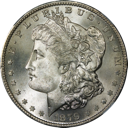
Grading the Kennedy Half Dollar
The Kennedy half (1964–present) changed metal three times: 90% silver in 1964, 40% silver 1965–1970, and copper-nickel clad from 1971 on. Wear shows first on Kennedy's cheek and the eagle's shield. Famous varieties include the 1964 Proof 'Accented Hair,' the 1974-D doubled die, and the 'No FG' coins; the 1970-D (Mint-Set-only) is the key business strike.
Last reviewed: · Free to read · Every claim sourced
New to grading? Start with how to grade a coin, step by step, and the Sheldon 1-70 scale.
At a glance
| Years | 1964–present |
|---|---|
| Designer | Gilroy Roberts (obv) / Frank Gasparro (rev) |
| Denomination | Half Dollars |
| Composition | 1964: 90% silver. 1965–1970: 40% silver clad (net 40% silver). 1971–present circulation: copper-nickel clad. Modern silver proofs: 90% silver (1992–2018) then .999 fine (2019+). |
| Diameter | 30.61 mm |
| Weight | 1964: 12.50 g · 1965–1970: 11.50 g · 1971+ clad: 11.34 g |
| Edge | Reeded |
| Mints | Philadelphia (P from 1980; no mark earlier), Denver (D), San Francisco (S, proofs), West Point (W, special issues) |
Major subtypes
| Subtype | Years |
|---|---|
| 90% silver | 1964 |
| 40% silver clad | 1965–1970 |
| Copper-nickel clad | 1971–present |
| Bicentennial (Independence Hall reverse, Seth Huntington) | 1776–1976 |
Where wear shows first
- Kennedy's cheek/cheekbone (highest obverse point)
- Eagle's shield (highest reverse point)
- Eagle's tail feathers
Other points to check
- Eyebrow, base of neck, and two spots in the hair (obverse)
- Eagle's wing tips, legs/claws, and lettering (reverse)
Common weak-strike areas
- Eagle's shield lines and breast/leg feathers (reverse)
- Highest hair detail above the ear (obverse)
- Eagle's claws/arrows on clad issues
Strike designations
No official full-strike designation exists for Kennedy halves; CAM/DCAM are proof finish designations, not strike-completeness designations.
Grading circulated coins
Most halves circulated lightly after 1964 (many never circulated), so survivors are usually AU–MS. Grade off the cheek and hair spots, and check the eagle's shield and tail feathers for flattening; AU shows just a trace of friction on the cheek and shield with most luster present.
Grading Mint State coins
The prime focal area is Kennedy's cheek and the field around the portrait, where contact marks and luster breaks cap the grade; on the reverse, marks on the eagle's shield/breast matter most. Heavily produced 1964 issues are hard to find truly mark-free, so high MS grades carry premiums.
Proof grading
Proofs from S (1968+) and earlier P (1964). Cameo / Deep Cameo matter, especially for 1964 (including 1964 Accented Hair DCAM). The 1998-S matte proof and 2014 reverse/enhanced finishes are graded as special strikes; watch for artificially frosted cameos.
Key dates
- 1970-D (Mint-Set-only, ~2.15M, key business strike)
- 1987-P & 1987-D (Mint-Set-only)
Semi-key dates
- 40% silver circulation strikes (1965–1969); common, but condition rarities in high Mint State
Major varieties
- 1964 Proof 'Accented Hair' (extra hair lines left of the part)
- 1974-D Doubled Die Obverse (doubling in TRUST)
- 'No FG' dates: 1966 SMS, 1972-D, 1982-P (initials polished off the die)
- 1964-D DDO
Common problems
- Cheek bag marks on MS coins
- Spotting/milk-spots on modern silver and clad
- Weak eagle-shield detail
- Misattributed varieties (No FG, 1974-D DDO)
Signs of cleaning or damage
- Hairlines and unnatural shine on the open cheek and fields
- Impaired/dull luster
- Scratches (the clad surface marks easily)
Toning
1964 (90%) and 1965–1970 (40%) silver coins tone like other silver (album/rainbow); clad issues tone less and can develop spotting.
Counterfeit & alteration risks
- Altered/added 'Accented Hair' or faked DCAM on 1964 proofs
- Counterfeit or altered 2014-W gold anniversary coins
- Faked No-FG and 1974-D DDO attributions
For the advanced grader
Identify the composition first (1964 silver, 1965–1970 40% silver, 1971+ clad; 2019+ silver proofs are .999), since it drives value and authentication. Grade MS coins off the large open cheek and the eagle's shield where marks and luster breaks concentrate; with no strike designation, premiums ride on surface preservation plus CAM/DCAM for proofs.
Photographic examples
Click any image to enlarge and zoom. Where shown, obverse, reverse, and edge views are of the same coin and year.
Same coin: Kennedy half dollar (U.S. Mint)
More half dollars to explore
Sources: Professional Coin Grading Service (PCGS) · Numismatic Guaranty Company (NGC) · United States Mint · Coin World
Evidence pages
Related terms
Doubled Die · Cameo (CAM / CA) · Deep Cameo / Ultra Cameo (DCAM / UC) · Contact Marks · Business Strike (Circulation Strike) · Machine Doubling